Geoda.ch

Radon and your health

Radon is a naturally occurring radioactive gas that can accumulate in indoor air and pose a health risk. In Switzerland, radon exposure is the second leading cause of lung cancer after smoking and is estimated to cause around 300 deaths each year. The risk of indoor radon exposure varies significantly depending on local geology and building characteristics. Geoda.ch allows you to look up any Swiss address and provides an address-specific overview of the most important radon risk factors for the building

Radon is an odorless, invisible, radioactive gas produced from the decay of naturally occurring uranium in the ground. Radon can seep into homes and buildings through small cracks or holes in the subsurface, and its gaseous form can have significant negative health effects.

The geology of Switzerland means that the risk for radon pollution is relatively high throughout the country, and especially in the more mountainous regions (see map below) - Radon ought therefore to be a major concern for Swiss homeowners, homebuyers, landlords, and building managers. It is estimated that Radon is the second leading cause of lung cancer in Switzerland, second only to smoking, and responsible for 200-300 deaths a year[1].
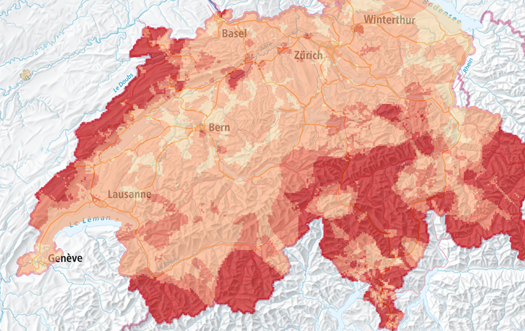
Radon Map

Map showing the risk of radon pollution in Switzerland. The map data is from the Swiss Federal Office of Public Health (FOPH). The map shows estimated radon risk data, and the actual concentrations in buildings might be both higher and lower.[2].

The World Health Organization (WHO) recommends that its member countries have a national annual average residential radon concentration reference level of 100 Bq/m³ (Becquerel per cubic metre). According to WHO, the risk of lung cancer increases by about 16% per 100 Bq/m³ increase. [3] The Swiss reference level is three times higher than the WHO recommendation at 300 bq/m³. The risk map (above) and the risk analysis is based on the relatively high Swiss 300 bq/m³ reference level. The maximal indoor radon concentration set down in Swiss law is 1,000 bq/m³. [4]

Our forefathers appear to have also worried about radon, as tradition holds that builders once observed ants when choosing where to build. According to these accounts, anthills were moved to a planned building site, and locations where ants remained were avoided. Modern research offers a possible explanation for this practice, as European red wood ants are known to prefer nesting along geological fault zones, where soil gases such as radon are more likely to rise to the surface. [5]

Evaluate the risk of indoor radon pollution with Geoda.ch

Geoda’s radon risk evaluation is built in layers. First, we start with the radon risk probability from the Federal Office of Public Health (FOPH) radon map—i.e., the probability (in %) that buildings in the area exceed the Swiss reference level of 300 Bq/m³.

Second, we adjust that baseline slightly using the building’s characteristics shown in the report: building age and building type. In practice, buildings built before 1980 receive a small increase in risk, while newer buildings (2000+) receive a small decrease; multifamily buildings receive a small decrease. The construction-year adjustment reflects that building practices and requirements have gradually improved: SIA 180 (first published in 1989 and revised multiple times, e.g. 1999, 2006, 2014) increasingly incorporated guidance on sealing the building envelope against soil gases (including radon), and in 2018 Switzerland updated the Radiological Protection Ordinance, lowering the reference level from 1,000 Bq/m³ to 300 Bq/m³, in line with newer international recommendations (e.g., from WHO).[6]

Thirdly, we include the building type. Multifamily buildings receive a small downward adjustment because radon risk is most closely tied to rooms with floors in direct contact with the ground (typically basements and ground-floor rooms in buildings with slab-on-grade construction). In apartment buildings, a smaller share of dwellings are directly exposed to ground-contact pathways, so the expected indoor risk for residents is typically lower—this is why Geoda includes building type (including whether the property is a multi-storey/multifamily building) as part of the evaluation.

The adjusted score is then grouped into a simple green / yellow / red indicator (as in the example report, where a 2% baseline probability results in a green indicator, and the building’s type and construction year are explicitly treated as key factors).

This methodology is approximate and does not replace on-site radon measurements. It is designed to be broadly consistent with the logic behind the official FOPH radon risk evaluation.[7]

Radon protection measures

If you're uncertain about the radon risk in your living space, we recommend following the three-step plan below: "check", "measure", and "protect". This will help safeguard you and your loved ones from the dangers of radon exposure.

  • Check radon risk on your address. It's simple to assess the radon risk at your home, workplace, child's school, or any other address of interest. Enter the address into the Geoda.ch search bar to receive a housing report, that includes a radon risk evaluation. Additionally, you can obtain a risk estimate from the Swiss Federal Office of Public Health (FOPH) website. [8] Keep in mind that, these are merely 'risk estimates' and don't provide information on the actual radon levels at the specified address.
  • Measure radon in your home. It is a good idea to measure your home for radon regularly, especially if you live/work at an address with elevated risk. The radon risk is particularly high in basement and ground-level rooms. Radon infiltrates the interior of a building through leaks in floors and walls in direct contact with the soil, so basement and ground floor levels . Something called the stack effect causes a suction effect in the winter in particular. Heated air rising within the house causes the air pressure in the basement and the lowest floors to drop by a barely perceptible amount. The ensuing suction effect, amplified by fans or fireplaces, causes radon and other gases to be drawn into the upper stories unless the basement and ground floor are sealed off with airtight doors. The Swiss Federal Office of Public Health (FOPH) makes available a list of recognized radon measurement stations to purchase and evaluate dosimeters. The costs are a modest 70 to 100 Swiss francs. [8]
  • Protect yourself from radon. There are several ways to reduce radon levels in indoor spaces, including sealing cracks and openings in the foundation, installing a radon ventilation system, and using a radon-reducing soil treatment. A radon-proof new building with a sealed foundation slab is estimated to cost an additional 2000 Swiss francs per single-family dwelling; a radon rehab runs about 4,000 to 8,000 Swiss francs.

    “There are straightforward, low-cost means available to protect a building from excessive radon exposure.”

    Federal Office of Public Health [8] Read more

In summary, it is crucial to consider radon and health in your place of residence. Given the significant health risks posed by radon in Switzerland, and also considering that there are straightforward, low-cost means available to protect a building from excessive radon exposure. We strongly recommend to always include radon risks, when making decisions on purchase of real estate or moving into a rented property.