One in seven people in Switzerland is exposed to excessive noise pollution, making the country one of the least tranquil in Europe. Traffic noise and the lack of quiet environments are associated with adverse health effects and a reduction in life expectancy. It is estimated that the Swiss population loses around 69,300 healthy life years each year[1]. due to noise exposure. These are years that could otherwise have been lived in good health. Geoda.ch helps you explore traffic noise and tranquility levels at and around your address, supporting more informed decisions about your living environment.
As the world grows louder, silence and calmness has become the ultimate luxury - a serene refuge from the cacophony of daily life. Unfortunately, many of us are not so lucky as to live in tranquil isolation from noise and human made disturbances. In Switzerland, around 600,000 residential units are affected by a significant amout of traffic noise during the day and about 530,000 at night [1]. The dense road network and the high population density in many parts og Switzerland make it difficult for the government to remedy the problem.
Recent evidence highlights the impact of environmental noise on cardiovascular health. Environmental noise and lack of tranquility are considered the second-largest environmental cause of premature death in the EU after air pollution. Research indicates that adverse health impacts are likely at 55 dB (day) and 45 dB (night) [2].
“The constitutional goal of protecting the population from excessive noise has therefore not been achieved yet. ”
At Geoda.ch we provide comprehensive information on traffic noise and tranquility for all Swiss addresses. Whether you're considering a new place to live or simply curious about your current area's tranquility, Geoda.ch helps you make informed decisions based on open-source data, supplied by the Swiss government [3].
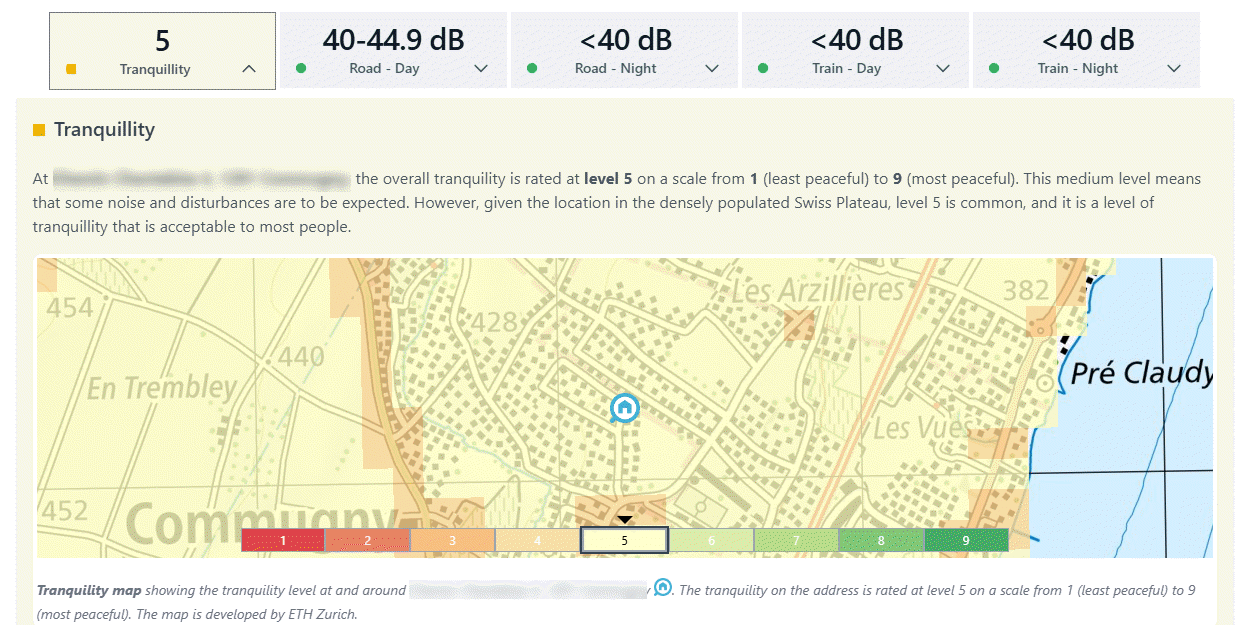
A Geoda.ch housing report offers detailed information about traffic noise and tranquility for any Swiss address. It provides digitized values for the following nine parameters:
Tranquillity: Overall tranquility index (1–9) combining positive and negative environmental factors.
Each parameter has an expandable explanation and a contextual map for visual assessment.
Tranquility Data
The Tranquility Index ranges from 1 (least peaceful) to 9 (most peaceful) and combines positive and negative environmental factors.
Positive factors
Natural landscapes (forests, mountains, open space).
Trees and greenery (vegetation dampens noise).
Rivers and water bodies with calming effect.
Birdsong and natural soundscapes.
Absence of man‑made noise and light pollution.
Negative factors
Constant vehicle noise (road & rail).
Crowds and high population density.
Dense urban development and hard surfaces.
Night‑time light pollution.
Low‑flying / frequent aircraft.
Calculated tranquility (Swiss Plateau) based on ETH study.
Traffic noise
Although people adapt, chronic traffic noise still imposes physiological stress linked to cardiovascular and metabolic effects; WHO guidelines highlight health risks above 55 dB (day) and 45 dB (night).
Sleep disturbance, stress, impaired cognition and reduced quality of life accumulate over years; addressing noise early helps preserve long‑term health.
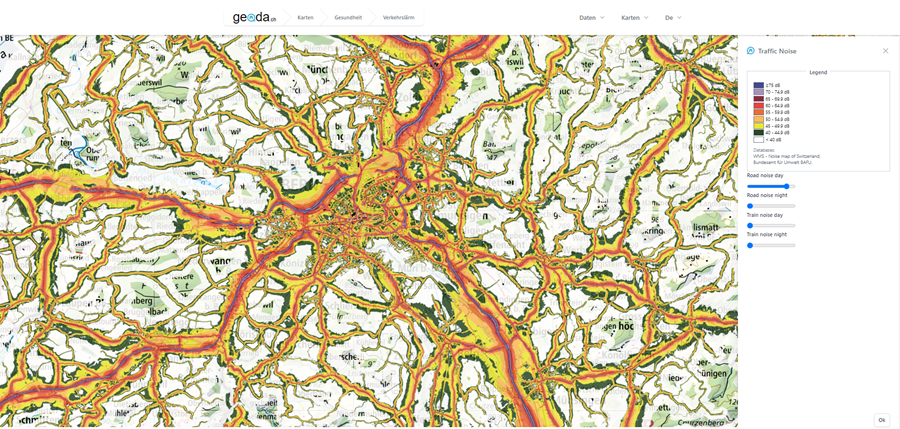
Traffic noise exposure in Switzerland, modelled by the Federal Office for the Environment
Noise also generates economic losses: reduced property values, lower area attractiveness and healthcare costs. External costs of traffic noise in Switzerland were estimated at CHF 2.83 billion in 2019 (≈80% road).